 Inventors Den
Subscribe !!!
Inventors Den
Subscribe !!!
I Built A Full Split System AC Using Peltier Modules
Project overview This project is Part 3 of the DIY Peltier air conditioner series. After testing earlier prototypes, the goal was to build something much closer to a…
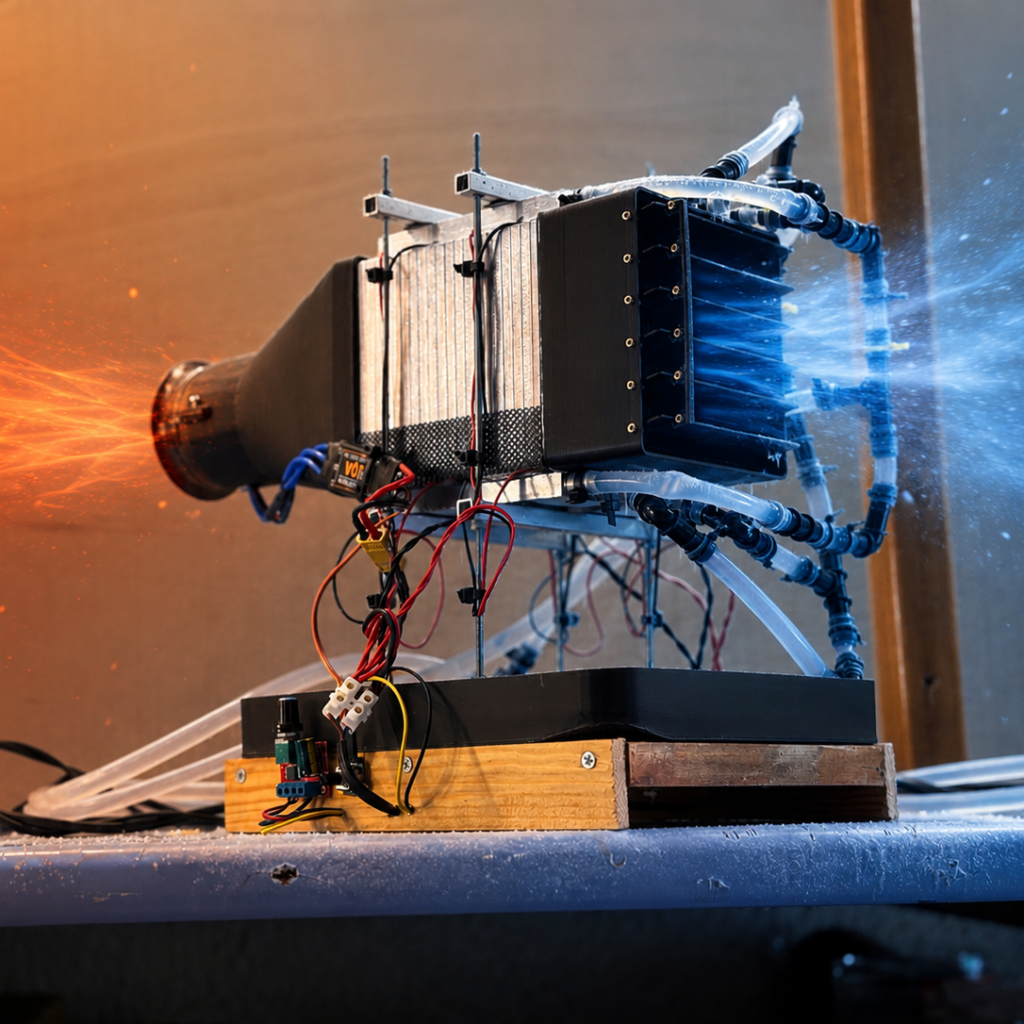
Project overview
This project is Part 3 of the DIY Peltier air conditioner series. After testing earlier prototypes, the goal was to build something much closer to a real split air conditioning system, with a dedicated indoor cooling unit, an outdoor heat exchanger, water cooling, and much larger airflow.
The system worked and reduced the room temperature by about 1.5°C, but the test also revealed a major limitation: the supposedly 135W Peltier modules only consumed around 40W each in real-world testing.
Embedded video
Features
Split AC layout
A dedicated indoor cooling unit and outdoor heat exchanger make the build closer to a traditional split air conditioner.
Custom indoor radiator
The indoor radiator was built from stacked precision-machined aluminum plates to create a large cooling surface and airflow tunnel.
Water cooling loop
Water circulates between the indoor and outdoor units to move heat out of the room more effectively than the earlier prototypes.
Higher airflow
A large indoor turbine blower and a powerful 220V outdoor fan move far more air through the radiators.
Real room testing
The test measured the temperature of the whole room, not just the air directly coming out of the cooler.
Peltier module verification
Electrical testing showed that the advertised 135W modules only consumed around 40W each.
Specifications
Thermoelectric Peltier modules
DIY split air conditioner
135W per module
About 40W per module
About 1.5°C temperature reduction
Large 220V cooling fan
The Article
Building a Real Peltier Split Air Conditioner – Part 3: Does a Thermoelectric AC Actually Work?
For nearly a year, the DIY Peltier air conditioner project has been evolving through testing, failures, and improvements. After the success of the first two prototypes and hundreds of suggestions from viewers, it was finally time to build something much closer to a real split air conditioning system.
Instead of simply placing the hot side outside the room, the goal of Part 3 was much more ambitious: design and build a proper Peltier split AC, featuring a dedicated indoor cooling unit, a large outdoor heat exchanger, water cooling, and significantly larger airflow.
The result? The system actually worked, but it also revealed one of the biggest problems with inexpensive Peltier modules available online.
Turning a DIY Cooler Into a Real Split Air Conditioner
The previous versions proved that thermoelectric cooling works, but they also highlighted several limitations.
For this iteration, nearly every component was upgraded:
- A much larger custom indoor radiator
- An automotive-sized outdoor radiator
- A powerful 220V outdoor cooling fan
- A large turbine blower for the indoor unit
- Water cooling between both units
- A complete split-system layout similar to a traditional air conditioner
The objective wasn’t simply to build another Peltier experiment. It was to answer a much bigger question:
Can a properly designed thermoelectric split air conditioner actually cool an entire room?
Designing a Custom Indoor Radiator
One of the biggest challenges quickly became the indoor radiator.
Standard radiators available online simply weren’t suitable for this project. They were either too small or didn’t match the required dimensions.
Fortunately, a custom solution made it possible to manufacture an oversized radiator specifically designed for this build.
Instead of machining one massive aluminum block, which would have required impossible 120 mm deep internal channels, the radiator was designed as approximately twenty precision-machined aluminum plates.
Once stacked together, they formed one large airflow tunnel capable of carrying water while exposing a huge cooling surface.
The process involved:
- Stacking every aluminum plate
- Aligning everything with steel rods
- Clamping the assembly
- Sanding and flattening the contact surfaces
- Compressing everything into a solid radiator
Although assembling dozens of plates required significant work, the final radiator turned out surprisingly rigid and perfectly flat.
Bigger Fans Mean Better Airflow
Airflow is just as important as cooling power.
The tiny fan used in previous versions was replaced with a large turbine capable of pushing far more air through the indoor radiator.
Outside, the small cooling fan was replaced by a much larger 220V fan designed to remove heat from the outdoor radiator much more efficiently.
These changes transformed the project from a desktop experiment into something that visually resembles an actual split AC system.
The Biggest Surprise: Fake 135W Peltier Modules
Perhaps the most important discovery of the entire project came after electrical testing.
The thermoelectric modules purchased for the build were advertised as 135W Peltier elements.
Unfortunately, reality was very different.
Power measurements showed that each module consumed only around 40 watts, nowhere near the claimed specifications.
This explained why the cooling performance wasn’t matching expectations despite using larger radiators and much better airflow.
It’s a reminder that many inexpensive Peltier modules sold online are heavily overrated, and buyers should always verify real-world power consumption instead of relying solely on product listings.
The cooling system itself wasn’t the main limitation. The thermoelectric modules were.
Water Cooling Worked Better Than Expected
The split system circulated water between the indoor and outdoor units to transfer heat away from the room.
Compared to earlier prototypes, the water loop provided much more stable temperatures and significantly improved thermal management.
The large custom radiator also offered considerably more cooling surface, helping maximize every watt available from the Peltier modules.
Even though the modules themselves underperformed, the overall cooling design proved to be far more effective than previous builds.
One Unexpected Challenge: The Pipe Routing
Not everything went according to plan.
As more components were added, the plumbing became increasingly difficult to organize.
Water tubes had to connect:
- Indoor radiator
- Outdoor radiator
- Pump
- Reservoir
- Multiple Peltier blocks
The result was a pipeline that looked far more chaotic than originally intended.
Although it functioned correctly, cable and tube management became one of the project’s weakest points.
Future versions will almost certainly require a cleaner layout with shorter tubing and a more integrated enclosure.
Real Room Cooling Results
After finally assembling the entire split system, it was time for the real test.
Unlike many online demonstrations that only measure air coming directly from the cooler, this experiment measured the temperature of the entire room.
Despite using Peltier modules that delivered only around one-third of their advertised power, the system successfully reduced the room temperature by approximately 1.5°C.
While this is nowhere near the performance of a conventional compressor-based air conditioner, it’s still an impressive result considering the limited thermoelectric power available.
The experiment clearly demonstrated that:
- The cooling concept works.
- The split-system design is effective.
- Better quality Peltier modules could significantly improve performance.
What Comes Next?
This project represents a major step forward in DIY thermoelectric air conditioning.
The custom radiator, larger fans, and split-system architecture proved that meaningful room cooling is possible using Peltier technology.
However, the disappointing performance of the supposedly “135W” modules also highlighted one of the biggest obstacles facing hobbyists: unreliable component specifications.
Future improvements could include:
- Genuine high-performance Peltier modules
- Better thermal insulation
- Cleaner water pipe routing
- More efficient cold plate design
- Higher-capacity power delivery
- Optimized airflow through the indoor unit
Each iteration moves the project closer to answering a fascinating engineering question:
Can a practical Peltier-powered split air conditioner eventually compete with traditional refrigeration systems?
Final Thoughts
Part 3 wasn’t just another upgrade. It was proof that engineering is often about discovering unexpected limitations.
The custom-built split system worked exactly as intended, successfully cooling the room by around 1.5°C, despite being held back by severely overrated thermoelectric modules.
While there’s still plenty of room for improvement, this project demonstrates how thoughtful engineering, custom manufacturing, and persistent experimentation can push DIY cooling technology far beyond simple desktop demonstrations.
The journey isn’t over yet, and the next version could finally unlock the full potential of a true Peltier-powered air conditioning system.
SEO Keywords
Peltier air conditioner, DIY air conditioner, Peltier AC, thermoelectric cooling, split air conditioner DIY, Peltier cooling project, custom radiator, thermoelectric air conditioning, DIY HVAC project, Peltier module review, fake 135W Peltier, water cooled Peltier, DIY split AC, homemade air conditioner, Inventors Den.
Downloads
Parts list
| Part | Quantity | Notes |
|---|---|---|
| Peltier module advertised as 135W | Multiple | Measured at around 40W each during testing. |
| Custom indoor radiator | 1 | Built from approximately twenty precision-machined aluminum plates. |
| Outdoor radiator | 1 | Automotive-sized heat exchanger for the hot side. |
| 220V outdoor cooling fan | 1 | Used to remove heat from the outdoor radiator. |
| Indoor turbine blower | 1 | Pushes air through the custom indoor radiator. |
| Water pump | 1 | Circulates water between the indoor and outdoor units. |
| Reservoir | 1 | Part of the water cooling loop. |
| Water tubing | As needed | Connects the radiators, pump, reservoir, and Peltier blocks. |
| Steel alignment rods and clamps | As needed | Used during custom radiator assembly. |
Gallery
FAQ
Did the Peltier split air conditioner actually cool the room?
Yes. In the full room test, the system reduced the room temperature by approximately 1.5°C.
Why was the cooling performance limited?
The main limitation was the Peltier modules. They were advertised as 135W modules, but testing showed they only consumed around 40W each.
What made this version different from earlier prototypes?
This version used a true split-system layout with a custom indoor radiator, a large outdoor radiator, water cooling, a powerful outdoor fan, and a larger indoor blower.
What would improve the next version?
Better Peltier modules, improved insulation, cleaner pipe routing, more efficient cold plates, stronger power delivery, and optimized airflow would all help improve performance.
Comments
Comments are closed for this post.

Comments
Comments are handled by the WordPress project page template.